



432Hz Converter - MultiEsoCon
Last updated on June 25, 2026 – IN MEDIAKG TI
Convert individual songs, complete music folders, and audio CDs to 432 Hz or other selected reference frequencies with MultiEsoCon.
MultiEsoCon is a Windows audio frequency converter designed for single-file conversion and high-volume batch processing. It supports target settings including 174 Hz, 285 Hz, 396 Hz, 417 Hz, 432 Hz, 528 Hz, 639 Hz, 741 Hz, 852 Hz, and 963 Hz. The software is intended for musicians, meditation-music producers, ASMR creators, sound designers, and listeners who want to compare alternative tunings using their own audio library.

MultiEsoCon changes the pitch reference of an audio file while keeping its running time unchanged. This makes it possible to create alternative versions of existing tracks without manually processing every file in an audio editor. Batch conversion is particularly useful for large folders, themed playlists, meditation albums, background-music collections, and archived CD material.
MultiEsoCon is an audio-production tool, not a medical device. Claims that a specific tuning can heal disease, repair DNA, or treat anxiety are not established by reliable clinical evidence.
MultiEsoCon batch conversion interface
Table of contents
- What a 432 Hz converter changes
- 432 Hz and 528 Hz conversion compared
- How to choose a music frequency converter
- How to convert music to 432 Hz
- Audio quality, formats, and batch processing
- Using retuned music for meditation and relaxation
- Frequently asked questions
What Does a 432 Hz Converter Do?
A 432 Hz converter changes the pitch of a recording so that music originally referenced to A4 = 440 Hz is reproduced with A4 at approximately 432 Hz. The entire recording is shifted downward by the same musical interval, which is about 31.8 cents. This is a small but measurable pitch change. It does not mean that every sound in the recording becomes a 432 Hz tone.For beginners, it helps to distinguish between reference pitch and an individual audio frequency. A reference pitch defines the tuning system used for the notes in a piece of music. When a complete song is converted from 440 Hz tuning to 432 Hz tuning, all notes move proportionally. The musical relationships remain intact, while the overall pitch becomes slightly lower.
Some listeners describe 432 Hz music as softer, warmer, or less bright than the original version. Others hear little or no meaningful difference. Listening impressions depend on the recording, playback equipment, volume, musical training, expectations, and personal preference. There is no accepted scientific basis for claims that 432 Hz matches a universal, planetary, or biological frequency.
Using 432 Hz Music for Meditation and Relaxation
Meditation music often uses slow tempos, sustained tones, gentle dynamics, nature sounds, drones, and repetitive patterns. These musical features can support a quiet listening environment. Retuning a track to 432 Hz changes its pitch, but it does not automatically make the composition relaxing. Arrangement, tempo, sound selection, volume, and the listener's setting usually have a greater practical influence on the experience.A 432 Hz converter can still be useful for creative comparison. You can prepare a standard version and a 432 Hz version of the same track, match their playback volume, and listen without knowing which version is playing. This simple A/B comparison is more informative than relying on labels or expectations. Use the version that sounds better to you.
Music may be part of a personal relaxation routine, mindfulness session, yoga practice, study playlist, or sleep-time environment. However, frequency-converted music should not be presented as a treatment for anxiety, insomnia, depression, pain, or another health condition. Persistent or severe symptoms require advice from a qualified healthcare professional.
Batch 432 Hz Converter vs. Batch 528 Hz Converter
| Aspect | Batch 432 Hz Converter | Batch 528 Hz Converter |
|---|---|---|
| Technical purpose | Retunes complete recordings to a selected 432 Hz reference setting. | Retunes complete recordings to a selected 528 Hz reference setting. |
| Batch processing | Processes multiple files or folders in one conversion queue. | Uses the same batch workflow with 528 Hz selected as the target. |
| Typical projects | Meditation music, ambient tracks, acoustic recordings, personal listening tests, and alternate masters. | Experimental sound projects, meditation playlists, ambient productions, and alternate-frequency collections. |
| Audible result | Produces a lower pitch than a version referenced to 440 Hz. | The audible result depends on the source tuning and the conversion method selected in the software. |
| Health claims | No reliable evidence shows that 432 Hz music heals illness or provides a unique medical benefit. | Claims involving DNA repair, cellular healing, or disease treatment are not supported by established clinical evidence. |
| Target users | Musicians, producers, sound designers, meditation-content creators, and private users. | Users producing experimental, spiritual, ambient, or frequency-themed audio. |
| File handling | Suitable for individual tracks, music folders, and supported audio-CD workflows. | Suitable for the same source material with a different target frequency selected. |
| Selection criterion | Choose it when you prefer the sound or need a 432 Hz version for a specific production. | Choose it for creative or organizational reasons, not because of unverified therapeutic promises. |

Frequency selection in the 432 Hz converter
What Research Can and Cannot Tell Us About 432 Hz Music
A small number of exploratory studies have compared music tuned to 432 Hz with music tuned to 440 Hz. Some reported differences in selected physiological measurements or self-reported responses. These findings are preliminary and do not establish that 432 Hz has a specific healing mechanism. Small samples, limited study designs, different listening conditions, and the difficulty of controlling expectations make broad conclusions inappropriate.Research on music-based interventions more generally is a separate topic. Music listening and professionally delivered music therapy may support comfort or symptom management in some settings, but outcomes depend on the intervention, patient group, context, and study quality. Evidence about music in general must not be used as proof that one particular tuning frequency treats a medical condition.
The practical conclusion is straightforward: use 432 Hz conversion as an audio-production choice or personal listening preference. Do not describe it as a cure, substitute it for medical care, or promise guaranteed changes in mood, sleep, concentration, heart rate, stress, or physical health.
How to Choose a 432 Hz Converter
A useful 432 Hz audio converter should provide accurate pitch processing, clear output settings, stable batch operation, and support for the file formats used in your workflow.When comparing desktop frequency converters, examine the following points:
- Pitch accuracy: The software should apply the selected conversion consistently across the complete file.
- Tempo preservation: For most music-library conversions, the running time should remain unchanged.
- Batch conversion: A folder-based queue saves time when processing albums or large music collections.
- Output formats: Check compatibility with the formats you use, such as MP3, WAV, FLAC, AAC, or other supported types.
- Sample rate and bit depth: Suitable export options help prevent avoidable quality loss in production workflows.
- Metadata handling: Album, artist, title, track number, and cover information may be important when converting organized libraries.
- Preview and comparison: A practical workflow should make it easy to compare the source and converted versions.
- Operating-system compatibility: Confirm that the program supports your Windows version and hardware.
Questions to Ask Before Converting a Large Music Library
Before starting a batch job, decide whether you need a listening copy, an editable production file, or a long-term archive. Test several representative tracks first, including vocals, acoustic instruments, dense electronic mixes, and quiet ambient recordings. Listen for changes in transients, stereo image, high-frequency detail, and low-level background noise.Keep the original files. Frequency conversion is a derivative process, so the source library should remain unchanged and backed up. If a high-resolution master will eventually be reduced from 24-bit to 16-bit, dithering belongs at the final bit-depth conversion stage rather than before retuning the audio with the 432Hz converter. Use a separate destination folder and a clear naming pattern such as Artist - Title - 432Hz. This prevents converted files from being confused with the original masters.
Step-by-Step: How to Convert Music to 432 Hz
To create a 432 Hz version, add your audio files, select 432 Hz as the target, choose the output format and destination folder, and start the conversion.- Prepare the source files. Use the highest-quality version available and confirm that you have permission to modify the recording.
- Add a file, folder, or supported audio CD. For large collections, use the batch import function.
- Select the target frequency. Choose 432 Hz or another available setting required for the project.
- Choose the output format. Select settings appropriate for playback, editing, distribution, or archiving.
- Set the destination folder. Store converted files separately from the originals.
- Run a short test. Convert one or two tracks before processing an entire library.
- Check the result. Compare pitch, loudness, duration, metadata, and audible quality.
- Start batch processing. Once the settings are verified, convert the remaining files.
Creative Uses for Retuned Audio
A music frequency converter can support several non-medical production tasks. Producers can create alternate masters, compare tuning references, prepare meditation-music catalogs, standardize a themed album, or retune background material before a mix. Musicians may use converted practice tracks when experimenting with instruments tuned to a different reference pitch.For meditation, yoga, breathing exercises, or quiet background listening, focus on the complete sound design rather than the frequency label alone. Moderate volume, low distortion, smooth dynamics, and a suitable listening environment are more practical considerations than claims about hidden vibrations or universal resonance.
"MultiEsoCon" 432 Hz Converter – Demo Music
Demo video: 432 Hz Converter – YouTube channel – watch on YouTube
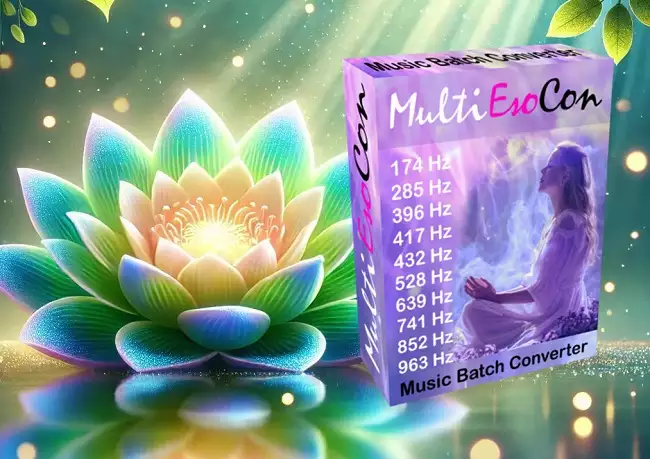
432 Hz and 528 Hz conversion options
FAQ About the 432 Hz Converter
What is a 432 Hz converter?
A 432 Hz converter is audio software that retunes a recording to a reference pitch associated with A4 = 432 Hz. When converting music from A4 = 440 Hz, the complete recording is shifted slightly downward while the musical intervals remain proportional.
Why do people convert music from 440 Hz to 432 Hz?
People usually convert music to compare alternative tunings, create meditation or ambient versions, match a production concept, or follow a personal listening preference. The choice is artistic and subjective rather than medically necessary.
What is the difference between 440 Hz and 432 Hz tuning?
A4 = 440 Hz is the standard reference pitch specified by ISO 16. A4 = 432 Hz is an alternative reference pitch. Converting from 440 Hz to 432 Hz lowers the recording by about 31.8 cents, which is less than one third of a semitone.
Does 432 Hz music have proven healing properties?
No reliable clinical evidence establishes that 432 Hz music cures disease, repairs DNA, balances the body, or provides a unique therapeutic effect. Some small exploratory studies have reported limited differences, but they are not sufficient for medical claims.
Can 432 Hz music treat anxiety or sleep problems?
Music can be enjoyable and may support a relaxing routine, but a 432 Hz conversion is not an established treatment for anxiety, insomnia, depression, or another health condition. Seek professional advice when symptoms are persistent, severe, or interfere with daily life.
Does conversion change the tempo?
A pitch-shifting converter can change the tuning while preserving the original duration and tempo. The exact result depends on the processing method and software settings.
Will converting music reduce audio quality?
Any pitch-processing step can introduce artifacts. The risk depends on the source quality, algorithm, conversion amount, export format, and encoding settings. Start with a lossless source and test the output before processing a complete collection.
Can I batch-convert an entire folder?
Yes. MultiEsoCon is designed to process multiple audio files in one queue, making it suitable for albums, playlists, archives, and large music folders.
Does 432 Hz music sound different to everyone?
No. Some listeners notice the slightly lower pitch immediately, while others perceive little difference. The response varies with the recording, playback system, listening conditions, and individual hearing.
Important information:
MultiEsoCon changes audio pitch and prepares alternate versions of recordings. It does not diagnose, prevent, treat, or cure medical conditions. Descriptions such as “healing frequency,” “love frequency,” “DNA repair frequency,” or “natural frequency of the universe” are cultural, spiritual, or promotional labels rather than established medical facts.
Research comparing 432 Hz with other tuning references remains limited. Preliminary findings from small studies should not be interpreted as proof of a clinical benefit. Music is a subjective experience, and preferences may differ considerably between listeners.
Use comfortable listening levels. For ongoing anxiety, sleep disturbance, pain, depression, or other health concerns, consult an appropriately qualified healthcare professional rather than relying on frequency-converted music.
MultiEsoCon changes audio pitch and prepares alternate versions of recordings. It does not diagnose, prevent, treat, or cure medical conditions. Descriptions such as “healing frequency,” “love frequency,” “DNA repair frequency,” or “natural frequency of the universe” are cultural, spiritual, or promotional labels rather than established medical facts.
Research comparing 432 Hz with other tuning references remains limited. Preliminary findings from small studies should not be interpreted as proof of a clinical benefit. Music is a subjective experience, and preferences may differ considerably between listeners.
Use comfortable listening levels. For ongoing anxiety, sleep disturbance, pain, depression, or other health concerns, consult an appropriately qualified healthcare professional rather than relying on frequency-converted music.